Why learn Chinese? 8 reasons worth the effort
More people speak Mandarin Chinese as their first language than any other language. It opens up the world’s second-largest economy and travel in China, Taiwan and Singapore, and it gives you films, music, games and books that few foreigners enjoy in the original. It is also more learnable than its reputation: the grammar is simple, pinyin spells every sound with the Latin alphabet, and the 1,000 most common characters cover 89% of everyday text. The characters and the tones are what take time.
Hanzio teaches Chinese from your first word: vocabulary, across its meaning, pinyin and tones, writing and sound, as well as grammar lessons and short stories for HSK 1.
Disclosure: we make Hanzio. The sources for every figure are at the end of the post.
1. Over a billion speakers
Mandarin is the official language of mainland China and Taiwan, and one of the four official languages of Singapore. Over a billion people speak it, about 1 in 7 people in the world. Counting only first languages, no language has more speakers. Counting second languages too, English comes first and Mandarin second.
Then there are the Chinese communities abroad, from Malaysia to the Chinatowns of cities around the world. Many people learn Chinese for someone: a partner and their family, grandparents whose language they never learned, friends or colleagues. Few foreigners speak it, so even a few sentences tend to be noticed.
2. Work and business
China is the world’s second-largest economy at market exchange rates, and the largest measured by purchasing power, in the IMF’s October 2026 figures. It is also the largest exporter of goods: 14.4% of the world’s merchandise exports in 2025, by the WTO’s count. Many companies buy from, sell to or compete with Chinese ones.

For a career, Chinese makes the skills you already have worth more. An engineer, a buyer or a lawyer who can follow a meeting, read an email or talk over dinner without an interpreter is rare, because Chinese takes time to learn, and that is exactly why it stands out on a CV.
3. Travel
There is nowhere else quite like China to visit. It has 61 UNESCO World Heritage sites, among the most of any country: the Great Wall, the Forbidden City and the Terracotta Army, and natural ones such as the karst peaks around Guilin. Every region cooks differently too, from Sichuan’s numbing peppercorns to Cantonese dim sum.
And mainland China has become much easier to visit. Since late 2023, citizens of a growing list of countries, most of Europe, Australia, Japan and South Korea among them, can stay up to 30 days without a visa (currently until the end of 2026). Travellers from 57 countries, the United States and the United Kingdom among them, can stop over for up to 240 hours, ten days, on their way to a third country.
Once you are there, Chinese makes the difference. Outside the big cities little English is spoken, and menus and signs are often only in Chinese. Mandarin also takes you around Taiwan and Singapore, and many Chinese Malaysians speak it too.

4. Films, series, music, games and books
Chinese has one of the largest bodies of film, music and writing of any language, and only a small part of it is translated. Chinese series and animation stream around the world, Mandopop has stars who fill stadiums across Asia, and games such as Black Myth: Wukong are made in China with Mandarin voice acting. Behind them stand the classics they keep returning to: Journey to the West, the novel that Wukong, the Monkey King, comes from, and the poets of the Tang dynasty.

Some things never survive translation, because they live in the sound. At Chinese New Year, families serve a fish and say 年年有余 niánnián yǒu yú, “may you have more than enough every year”. Its last word, 余 yú, “surplus”, sounds exactly like 鱼 yú, “fish”: the fish is on the table for its name. A translation gives you the wish, but not the pun.
5. A whole internet of its own
About 1.1 billion people in China were online at the end of 2025, by CNNIC’s count, and most of them use platforms of China’s own: WeChat for messages and payments, Douyin, the Chinese version of TikTok, Bilibili for video and Xiaohongshu for reviews and tips. Most of what is written and said there is in Chinese only. If you want to follow what people in China are talking about, in their own words, that is where it happens.
6. Words you can take apart
Chinese builds its words out of characters, and the logic is often right on the surface:
| Word | Literally | Meaning |
|---|---|---|
| 火山 huǒshān | fire mountain | volcano |
| 火车 huǒchē | fire vehicle | train |
| 手机 shǒujī | hand machine | mobile phone |
| 飞机 fēijī | flying machine | aeroplane |
Learn 机, machine, once, and it turns up in both 手机 and 飞机; learn 火, fire, and you have half of 火山 and 火车. Our post on writing characters shows how far a single character goes: 电, electricity, gives you the words for telephone, computer, television and film.
The characters themselves are built from parts that hint at their meaning and their sound, and they have a long history. The oldest Chinese writing we have was carved on bones and shells more than 3,000 years ago, and it is the direct ancestor of the characters printed today, which makes Chinese one of the oldest writing systems still in use.
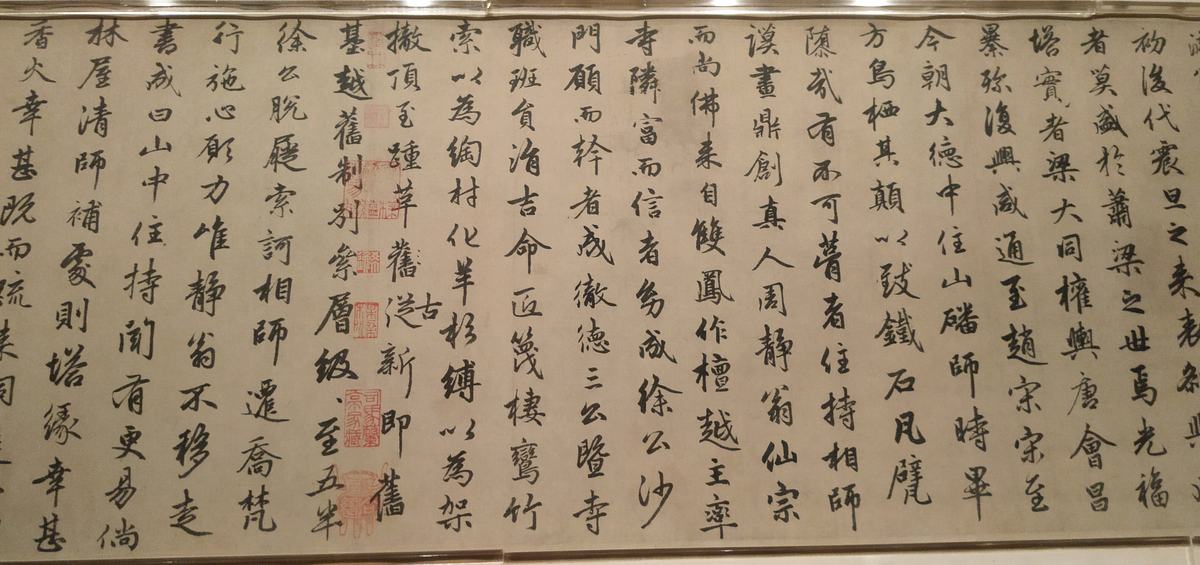
Writing them is an art, too. Calligraphy, written with a brush, has been one of China’s most admired arts for centuries, and since 2009 UNESCO has listed it as part of the world’s intangible cultural heritage. When you know the characters, you appreciate its beauty all the more: you see what each one says, and how the brush shaped it.
7. Progress you can measure
Chinese comes with a ready-made ladder: the HSK, the official Chinese exam. Its new version, which officially launches worldwide on 13 December 2026, starts with 300 words at the first level: at 10 new words a day, a month. Every level after it is a goal you can see and a certificate you can earn, so the long climb comes in stages.

And you feel the progress: the first time you read a sign, order from a menu or catch a line of a film without the subtitles, the effort pays for itself.
8. A head start on Japanese, Korean and Vietnamese
Japanese still writes with Chinese characters, and much of the vocabulary of Korean and Vietnamese came from Chinese centuries ago. 学生, student, is xuésheng in Mandarin, gakusei in Japanese, haksaeng in Korean and học sinh in Vietnamese. Learn Chinese first, and the others start with words you half know.
Is Chinese as hard as people say?
The US Foreign Service Institute, which trains American diplomats, puts Mandarin in its hardest group, with Arabic, Cantonese, Japanese and Korean, and plans about 88 weeks of full-time classes, 2,200 class hours, to reach a professional level. But that is the time it takes to work in the language, and not every part of it is hard: some parts are harder than in other languages, and some are much easier.
What is hard
- Characters. Each one has to be learned, and there are thousands. They get easier as you go, because new ones are built from parts you already know, and the most common do most of the work: the 1,000 most common cover 89% of everyday text.
- Tones. Mandarin has four tones and a neutral one, and they change the word: 妈 mā is mum, 马 mǎ is horse.
- Few familiar words. If you speak a European language, hardly any Chinese words sound like yours, apart from a few loans such as 咖啡 kāfēi, coffee, and 沙发 shāfā, sofa.
What is easy
- Verbs never change. 我去 wǒ qù is I go, 他去 tā qù he goes: no conjugation and no tense endings. You say when with a word like 昨天 zuótiān, yesterday.
- No articles and no grammatical gender. Nouns are neither masculine nor feminine, and he and she both sound tā, though they are written differently (他, 她).
- Nouns don’t change in the plural. 一本书 yì běn shū is a book, 三本书 sān běn shū three books; words for people can take 们, as in 朋友们 péngyoumen, friends. What takes getting used to is the measure word. English uses one only for some nouns, as in a glass of water, but Chinese puts one between almost every number and noun, even for books: 本 in 三本书.
- The word order is familiar. A basic sentence runs subject, verb, object, as in English: 我学中文 wǒ xué Zhōngwén, I study Chinese.
- Pinyin spells every sound. It writes Chinese with the Latin alphabet, so you can read a new word aloud before you know its characters.
Most of the effort goes into remembering characters, tones and words, more than into rules.
How to start
- Pick a script. Simplified, unless you are heading for Taiwan, Hong Kong or Macau: see simplified vs traditional Chinese.
- Learn pinyin and the tones first. Spend your first days on the sounds and the four tones. Every word you learn afterwards is built on them.
- Learn words, a few every day. The 300 words of the new HSK 1 make a good first goal. A few new words a day, and a review of the ones you learned before, work better than a long session once a week.
- Pick up the grammar as you go. HSK 1 grammar shows the first level’s sentence patterns, each with an example.
- Learn characters through their parts. Write them from memory: our post on writing Chinese characters explains why.
- Listen from day one. Songs, series and videos train your ear for the tones long before you understand every word.
Learning Chinese with Hanzio
Hanzio is built to help you make that climb, one step at a time. For HSK 1 it has a course of grammar lessons in order, with short stories that bring in new words a few at a time. Its daily plan gives you new words each day and brings each one back just before you would forget it, reviewing it by meaning, pinyin and tones, writing and listening; a wrong tone counts as a wrong answer.
Its dictionary shows how common every word is, and characters built from parts break down into them, with memory hooks. And when you travel, take a photo of a menu or a sign, or pick one you took, and the camera scan looks up the Chinese in it.
Frequently asked questions
Is Chinese the most spoken language in the world?
By first-language speakers, yes: no language has more native speakers than Mandarin. Counting people who speak it as a second language too, English has more speakers, and Mandarin comes second. Over a billion people speak Mandarin, about 1 in 7 people in the world.
Is Chinese worth learning?
If one of these reasons is yours, yes: over a billion speakers, the world’s second-largest economy, easier travel to China, and a culture that few foreigners know in the original. It takes years to master, but the first milestones come within weeks.
How long does it take to learn Chinese?
It depends on the goal. For a professional level, the US Foreign Service Institute plans about 88 weeks of full-time classes for English speakers. The new HSK, which launches on 13 December 2026, starts with 300 words, a month at 10 new words a day; its HSK 4, 2,000 words, takes about seven months at the same pace, counting new words only.
Should I learn Mandarin or Cantonese?
Mandarin, unless you have a reason to choose Cantonese, such as family or a move to Hong Kong. Over a billion people speak Mandarin, the standard language of mainland China, Taiwan and Singapore, the one schools teach and the HSK tests. Cantonese is spoken mainly in Hong Kong, Macau and Guangdong. Even in Hong Kong, where 88% of people aged five and over spoke Cantonese at home in the 2021 census, more than half could also speak Mandarin.
Should I learn simplified or traditional characters?
Simplified, unless you are heading for Taiwan, Hong Kong or Macau: it is the script of mainland China, Singapore and Malaysia, and of the HSK. Our post on simplified vs traditional Chinese compares them.
Can I learn Chinese without learning characters?
You can learn to speak with pinyin alone, and in the first weeks that works well. To read, you need characters, and writing them from memory is the most reliable way to tell them apart, as our post on writing Chinese characters explains.
Start with your first words
Hanzio reviews every word by meaning, pinyin, writing and listening, breaks characters into their parts, and has an HSK 1 course. The dictionary is free.