How many Chinese characters are there, and how many do you need?
There is no single number. Unicode encodes more than 100,000 Chinese characters, but most are rare, historical or variant forms; China's official list for modern use has 8,105. To read, you need far fewer: in 33 billion characters of real Chinese, spoken and written, the 1,000 most common account for 89%, and 3,000 for 99%.
The short version
- ~170 characters covers half of everything you read
- ~510 characters covers 75%
- ~1,090 characters covers 90%
- ~2,310 characters covers 98%
- The first 500 do three quarters of the work. Characters 2,501-3,000 add 0.7%.
These numbers tell you how many characters you need. Hanzio helps you learn them: every dictionary entry shows how common the character or word is, and the app helps you remember each one: its meaning, its pinyin and tones, how it sounds and how to write it.
Where this comes from: we make Hanzio, a Chinese dictionary and study app, and these numbers come from our own frequency data.
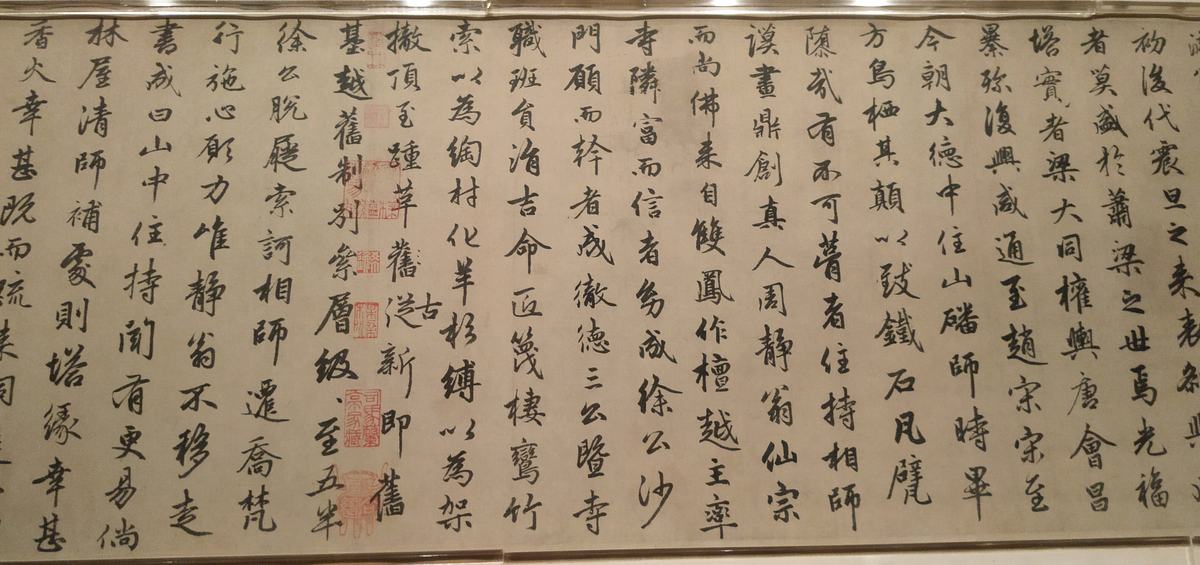
How many Chinese characters are there?
It depends on what you count. Each total below is real, and each one measures something different.
| Count | What it counts |
|---|---|
| 100,000+ | Chinese characters encoded in Unicode 17.0 (2025), the standard computers use for text |
| 85,568 | The Zhonghua Zihai (1994), the largest printed dictionary, variant forms included |
| 19,361 | Distinct characters in our own count of 33 billion characters of real Chinese |
| 8,105 | The Table of General Standard Chinese Characters (2013), China's official list for modern use |
| 3,500 | That table's first level, the common characters for basic education and literacy |
Even the 19,361 characters in our own count are mostly a long tail you will almost never meet.
How many characters do you need?
Here is how much of everyday text you cover as you learn characters, most common first:
Share of running text covered by the most common characters
The curve climbs steeply at first: the 100 most common characters already cover 40% of everyday text, 250 cover 59%, and 500 cover 75%. After about 1,500 it flattens, and each new character adds very little, because the characters left to learn are rare.
The number you hear most, 2,000 to 3,000, is not wrong. It is where coverage reaches 97-99%, the point where almost every character on a page is one you have seen before. But it is often quoted as the minimum you need before you can start reading, when most of the coverage comes from the first 1,000.
What you read changes the numbers a little. Spoken Chinese is the easiest: everyday dialogue reaches 90% at about 810 characters, while typical written text needs about 1,020.
What the percentages mean
Coverage is not comprehension. If you know the 1,000 most common characters, you cover 89% of the characters on a page. That sounds like nearly everything, but about one character in every nine is still one you don't know, and the unknown ones cluster where the information is: names, technical terms, the verb a sentence turns on. Even at 2,000, three characters in a hundred are new, which is reading with a dictionary, not comfortable reading.
Knowing characters is not knowing words either. 电 is electricity and 脑 is brain; 电脑 is a computer. Reaching the same 89% with whole words takes around 11,800 words, which is why characters are the efficient unit to start with, and why you still learn them inside words.
The first characters do most of the work
The 30 most common characters on their own account for about 23% of running text. These ones:
的我是了不在你有一人这个们大来他要上中为到会和好就国么以时生
They are mostly grammar, pronouns and the verbs every sentence needs, and you meet them on day one. Our guide to HSK 1 grammar shows how to use 的, 了, 是, 不, 在 and 有, and our list of the 100 most common Chinese characters gives all 100 with their pinyin and meaning.
What to learn first
- Frequency order for the first 1,000. While the curve is steep, a well-ordered list saves you hundreds of characters of effort. Start with the 100 most common.
- Characters inside words. A character on its own is a shape with a gloss; inside 电脑 or 意思 it comes with a word you can use. The HSK 1 word list is a good first set, and lookalikes are easier learned in pairs: see the characters beginners mix up most.
- Past about 1,500, read. The remaining characters are rare enough that you learn them by meeting them in context, and graded readers are built for that stage.
Learn them in the order that pays
Hanzio puts a 0-100 frequency score on every dictionary entry, so you can see at a glance which characters are worth learning first. The dictionary is free.
How we counted
The figures on this page come from Hanzio's own frequency data: 33 billion Han characters from large corpora of Chinese in spoken and written registers, weighted so that no single register dominates. Characters are counted as they occur in running text, inside longer words too, so each percentage is a share of the characters you actually meet. The counts are for simplified Chinese only; traditional Chinese has figures of its own.
Frequently asked questions
Is 2,000 characters enough to read a Chinese newspaper?
At 2,000 characters you know about 97% of the characters in running text, which sounds close but works out at roughly one unknown character every 34 - several per paragraph. You can follow a news article with a dictionary and guess a fair amount from context.
How many characters does a native speaker know?
Educated adult native speakers are usually estimated to know around 6,000 characters, and Chinese schooling targets roughly 3,500. Far fewer already cover most of the characters in everyday text, as the curve above shows.
Does Chinese have an alphabet?
No. Chinese is written with characters, and each one stands for a syllable, most of them with a meaning of their own, rather than letters that spell out sounds. Pinyin, the official romanization, does write Mandarin in the Latin alphabet, and it is how learners are taught pronunciation, but everyday Chinese text, from books to street signs, is written in characters.
Do these numbers apply to traditional characters?
No. Everything here was counted on simplified Chinese. The curve has the same shape for traditional characters, steep at the start and flat at the end, but the figures are different. For how the two scripts differ and which to learn, see simplified vs traditional Chinese.
Do I need to be able to write the characters by hand?
Recognising a character and producing it from memory are different skills, and every figure on this page is about recognition only. Handwriting does help many learners tell lookalike characters apart, and it is how most people finally notice that 未 and 末 are not the same shape, see whether you really need to write Chinese characters.